





























Login
Register
Top Leagues
Country
We use cookies to ensure that we give you the best experience on our website.


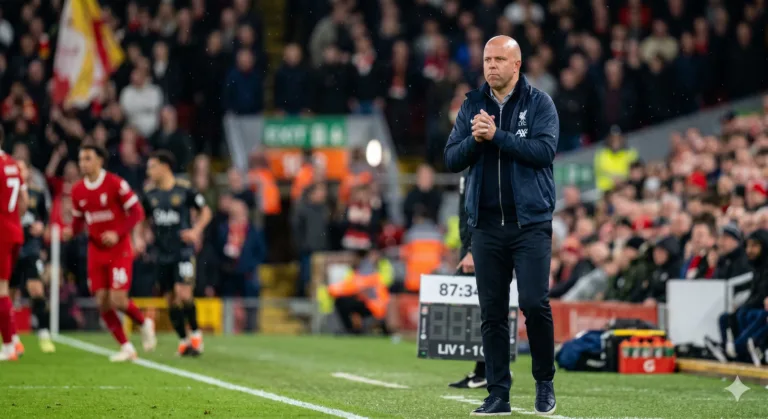
There is something especially frustrating about this Liverpool side under Arne Slot: for long stretches, they look organised, modern, and technically sound — and yet, when the stakes rise, the whole thing starts to wobble. They can control the ball, pin opponents back, and build pressure in advanced areas, but too often that control stops short of real damage.
That is why the current conversation around Liverpool cannot be reduced to lazy explanations like “bad finishing” or “a rough patch.” When the same issues keep resurfacing in high-level games, it stops looking like bad luck and starts looking like a structural problem.
Liverpool under Slot does not look like a bad team. It looks like an unfinished one.
At the heart of the issue is a simple but important contradiction: Liverpool no longer plays with the same relentless emotional violence that defined the Klopp years, but it has not fully evolved into a mature, ruthless control-based side either.
Slot’s version is calmer. The possession is cleaner. The structure is more deliberate. On paper, that should be progress. In practice, though, the trade-off has been obvious: the team often looks tidier without looking deadlier.
Control without vertical aggression quickly turns into sterile football.
Slot’s idea itself is not hard to understand. After a cycle built on emotional overload, pressing storms, and chaotic transitions, it was logical to try to give Liverpool more rhythm control and a more sustainable positional framework. Fewer wild end-to-end exchanges. More rest defence. More composure.
The problem is that football rarely rewards neat concepts unless they are backed by conviction, timing, and execution. Liverpool still has sequences where the circulation is sharp and the spacing looks right, but the final layer is often missing. The move reaches the edge of the box — then comes the extra touch, the delayed pass, the wrong shooting angle, or the lack of runners attacking the second ball.
In other words, Liverpool often creates the conditions for chances rather than the chances themselves. Against elite opponents, that difference is huge.
There is a big difference between occasionally losing to top sides and consistently looking fragile when top sides raise the tempo. Right now, Liverpool leans too often toward the second category.
That vulnerability shows up in a few recurring ways. First, the team is not always stable enough once the first press is beaten. If opponents escape the initial pressure, Liverpool can look too open between the lines and too loose in the wide channels. Second, the counter-press no longer feels as inevitable as it once did. There are still good spells, but fewer sustained waves of suffocating pressure. Third, in-game adaptations do not always feel proactive. Sometimes they look more like reactions to damage already done.
Elite teams punish hesitation. A half-second late in the press, one open half-space, one nervous pass inside your own shape — that is often enough.
The PSG tie said a lot about where Liverpool are in this project. Not simply because of the scoreline, but because of the feeling the team left behind. There were moments of decent pressure, promising entries into advanced areas, and stretches where Liverpool looked competitive. But once it became clear that PSG would survive those spells and wait for the right opening, Liverpool increasingly looked like the less complete side.
This is where tactical identity matters. It is not a problem for a top coach to adjust shape for a specific opponent. That can be smart. But if the adjustment makes the team look hesitant, overcautious, or disconnected from its own instincts, then flexibility starts to look more like uncertainty.
One of the defining patterns of this Liverpool side is that it can look dangerous without consistently becoming dangerous enough. The team can access the half-spaces, rotate well around the box, and stretch the opponent with good passing sequences. Yet the final outcome is too often underwhelming.
For betting analysis, that matters. A team can dominate territory and still underperform in truly high-value attacking moments. That is why box entries, shot locations, and second-ball presence often tell the deeper story beyond raw possession or total shot count.
Liverpool often looks one action short of being truly ruthless.
Under Klopp, Liverpool could be chaotic — but it was organised chaos, powered by conviction and emotional force. Opponents knew that if they lost control for even a short stretch, they could be overwhelmed by transitions, duels, second balls, and the noise of the game itself.
Under Slot, the team looks calmer, but calm is not the same as mature. A truly mature side does not just hold the ball; it controls the opponent’s options, kills momentum, closes spaces before they open, and turns positional advantages into decisive moments. Liverpool can still do some of that — just not often enough, and not consistently enough.
It would be lazy to place the entire decline on the head coach. Liverpool also has squad-level issues that shape the broader picture. Some key players have not been at their absolute peak. Some major names still do not look fully integrated into one coherent attacking structure. Rotation has occasionally broken rhythm, and physical limitations have clearly mattered in certain moments.
This is what makes transition seasons tricky. Strong individuals are not enough on their own. They need defined roles, repeatable connections, and a collective structure that sharpens their strengths instead of leaving them isolated inside it.
When a team is fully functioning, elite players amplify the system. Their influence becomes obvious. Their movement is anticipated. Their zones are protected and fed. Liverpool is not quite there yet. At times, the attacking unit still feels like a collection of high-level pieces rather than a finished, seamless front-foot mechanism.
That raises a few important questions. Who is the primary reference point in the final third? Who occupies the penalty area early? Who attacks the second phase? Who provides the final pass when the first structure breaks? Until those answers become clearer, Liverpool may continue to look expensive without always looking complete.
Big names do not automatically create a big-picture identity.
Not every problem is tactical. Some of this is emotional, and that matters just as much. When a team is under strain, you can usually see it in the details: lost second balls, sudden 10-minute collapses inside otherwise competitive games, rushed decisions in both penalty boxes, and a visible drop in confidence after one negative sequence.
Liverpool has shown several of those signs in major matches. That does not necessarily mean the dressing room is broken. It does mean the team still looks vulnerable when forced to live in chaos without fully trusting its new structure.
For readers looking at Liverpool through a betting and match-analysis lens, the key takeaway is this: do not evaluate Slot’s side through possession alone. Do not rely only on squad names, territory, or general “control” either. This is still a team that can look convincing for stretches while remaining fragile in the moments that matter most.
When assessing Liverpool in big matches, it makes more sense to focus on:
That is where the real story is. Not just in whether Liverpool plays “well,” but in whether the structure holds once the match turns hostile.
If this whole situation has to be reduced to one line, it is probably this: Arne Slot’s Liverpool is trying to become more mature without yet being mature enough, and trying to become more controlled without yet being cruel enough.
That is why the project feels incomplete. The old emotional violence has softened, but the new ruthless system has not fully arrived. Until those two worlds are reconciled, Liverpool may continue to look good in phases while still falling short where elite teams are judged most harshly.
Comments are closed.
Responsible Gambling Disclaimer
eScored content is provided for informational and analytical purposes only and does not constitute financial advice or encouragement to gamble. Predictions and statistics do not guarantee winnings. Betting involves the risk of financial loss and is intended only for adults of legal gambling age. You are solely responsible for your decisions and any resulting consequences. Always follow the laws of your jurisdiction and gamble responsibly.
Select matches to build your Betslip



çok bilgilendirici bir yazı olmuş ellerinize sağlık teşekkür ederim
I like the efforts you have put in this, regards for all the great content.
This is my first time pay a quick visit at here and i am really happy to read everthing at one place
hocam gayet açıklayıcı bir yazı olmuş elinize emeğinize sağlık.
Yazdığınız yazıdaki bilgiler altın değerinde çok teşekkürler bi kenara not aldım.
Hocam detaylı bir anlatım olmuş eline sağlık
gerçekten çok yararlı bi konu teşekkürler
Bilgiler için teşekkür ederim işime son derece yaradı
Verdiginiz bilgiler için teşekkürler , güzel yazı olmuş
Goede service, eerlijke prijzen en mooie toonzaalkeukens. Zeker interessant voor mensen die kwaliteit willen zonder de volle nieuwprijs te betalen.
Wij hebben gekozen voor een keuken op maat en zijn zeer tevreden met het resultaat. Mooie afwerking, goede communicatie en professionele montage.
Als je zoekt naar toonzaalkeukens te koop, kun je hier zeker slagen. Mooie modellen, scherpe prijzen en correcte service.
Professionele keukenmontage in Belgi�. De plaatsing werd op tijd uitgevoerd en alles werd netjes afgewerkt.
I very delighted to find this internet site on bing, just what I was searching for as well saved to fav
naturally like your web site however you need to take a look at the spelling on several of your posts. A number of them are rife with spelling problems and I find it very bothersome to tell the truth on the other hand I will surely come again again.
You’re so awesome! I don’t believe I have read a single thing like that before. So great to find someone with some original thoughts on this topic. Really.. thank you for starting this up. This website is something that is needed on the internet, someone with a little originality!
Bu güzel bilgilendirmeler için teşekkür ederim.
For the reason that the admin of this site is working, no uncertainty very quickly it will be renowned, due to its quality contents.
Pretty! This has been a really wonderful post. Many thanks for providing these details.
çok başarılı ve kaliteli bir makale olmuş güzellik sırlarım olarak teşekkür ederiz.
Goede service, eerlijke prijzen en mooie toonzaalkeukens. Zeker interessant voor mensen die kwaliteit willen zonder de volle nieuwprijs te betalen.
Aanrader voor keukenmontage Belgi�. Het team werkt netjes, snel en professioneel. Geen rommel en alles volgens afspraak.
Aanrader voor keukenmontage Belgi�. Het team werkt netjes, snel en professioneel. Geen rommel en alles volgens afspraak.
Zeer tevreden met onze keukenrenovatie. Alles werd duidelijk uitgelegd en de werken zijn goed uitgevoerd.
Phim Heo HD, Xem Phim Heo Gái Bướm Múp Không Che Hay Nhất
I really like reading through a post that can make men and women think. Also, thank you for allowing me to comment!
I appreciate you sharing this blog post. Thanks Again. Cool.
I’m often to blogging and i really appreciate your content. The article has actually peaks my interest. I’m going to bookmark your web site and maintain checking for brand spanking new information.
I am truly thankful to the owner of this web site who has shared this fantastic piece of writing at at this place.
Çok işime yaradı bende bunu nasıl yapacağımı araştırıyorum. Paylaşım için teşekkür ederim.
çok bilgilendirici bir yazı olmuş ellerinize sağlık teşekkür ederim
For the reason that the admin of this site is working, no uncertainty very quickly it will be renowned, due to its quality contents.
Çok işime yaradı bende bunu nasıl yapacağımı araştırıyorum. Paylaşım için teşekkür ederim.
I appreciate you sharing this blog post. Thanks Again. Cool.
çok bilgilendirici bir yazı olmuş ellerinize sağlık teşekkür ederim
I do not even understand how I ended up here, but I assumed this publish used to be great
Takipteyim kaliteli ve güzel bir içerik olmuş dostum.
Bu konuda internette çok fazla bilgi kirliliği vardı, ilaç gibi geldi.
Son zamanlarda okuduğum en net ve açıklayıcı makalelerden biriydi.
Gerçekten çok faydalı ve bilgilendirici bir içerik olmuş, emeğinize sağlık.
World Stock: Forex, Crypto & Trading Platforms
Gerçekten çok faydalı ve bilgilendirici bir içerik olmuş, emeğinize sağlık.
All the best
Yazınız için teşekkürler. Bu bilgiler ışığında nice insanlar bilgilenmiş olacaktır.
I am truly thankful to the owner of this web site who has shared this fantastic piece of writing at at this place.
Harika bir paylaşım, özellikle konunun önemli detayları oldukça net bir şekilde açıklanmış. İnsanları çeşitli karmaşık anahtar kelimelerle yormak yerine, okumaktan keyif alacağı içerikler her zaman daha iyidir. Kaliteli paylaşım adına teşekkür eder, paylaşımlarınızın devamını sabırsızlıkla beklerim.
For the reason that the admin of this site is working, no uncertainty very quickly it will be renowned, due to its quality contents.
Good post! We will be linking to this particularly great post on our site. Keep up the great writing
I very delighted to find this internet site on bing, just what I was searching for as well saved to fav
very informative articles or reviews at this time.
I very delighted to find this internet site on bing, just what I was searching for as well saved to fav
Emeğinize sağlık, bilgilendirmeler için teşekkür ederim.
I like the efforts you have put in this, regards for all the great content.
Enjoy every single day
Every day is a new beginning
Hahahaha You are so good
Good a blog toper