





























Login
Register
Top Leagues
Country
We use cookies to ensure that we give you the best experience on our website.


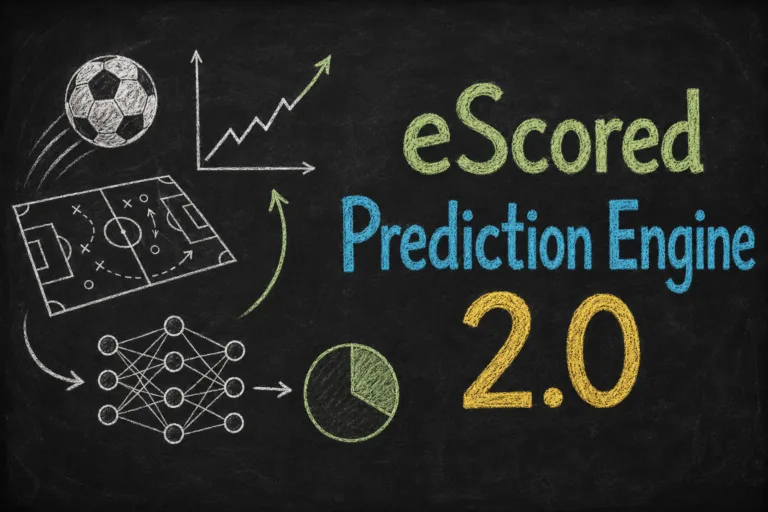
We have released a major upgrade to the eScored football prediction engine. The new system uses XGBoost machine learning to estimate expected goals, followed by a calibrated bivariate Poisson score matrix to calculate match probabilities across the markets available on eScored.
In a 2500-match live-style validation, the updated model reduced total-goal mean absolute error by 16.5%, cut total-goal bias by approximately 96%, and delivered lower Brier scores for 1X2, Over 2.5 and Both Teams to Score predictions compared with our previous Complex Poisson model.
This is not a cosmetic change. We rebuilt the most important part of the prediction pipeline: how eScored estimates the scoring potential of each team before a match.
Our previous model calculated expected goals through a complex set of manually weighted football factors. These included recent form, team attack and defence strength, xG, head-to-head data, ELO ratings, player availability, momentum and other adjustments.
That system was transparent and useful, but it had one important weakness: small errors from multiple manual adjustments could accumulate. In the latest benchmark, the legacy model overestimated the combined number of goals by an average of 0.619 goals per match.
The new model takes a different approach:
This hybrid structure combines the pattern-recognition ability of machine learning with the consistency of a full football score matrix.
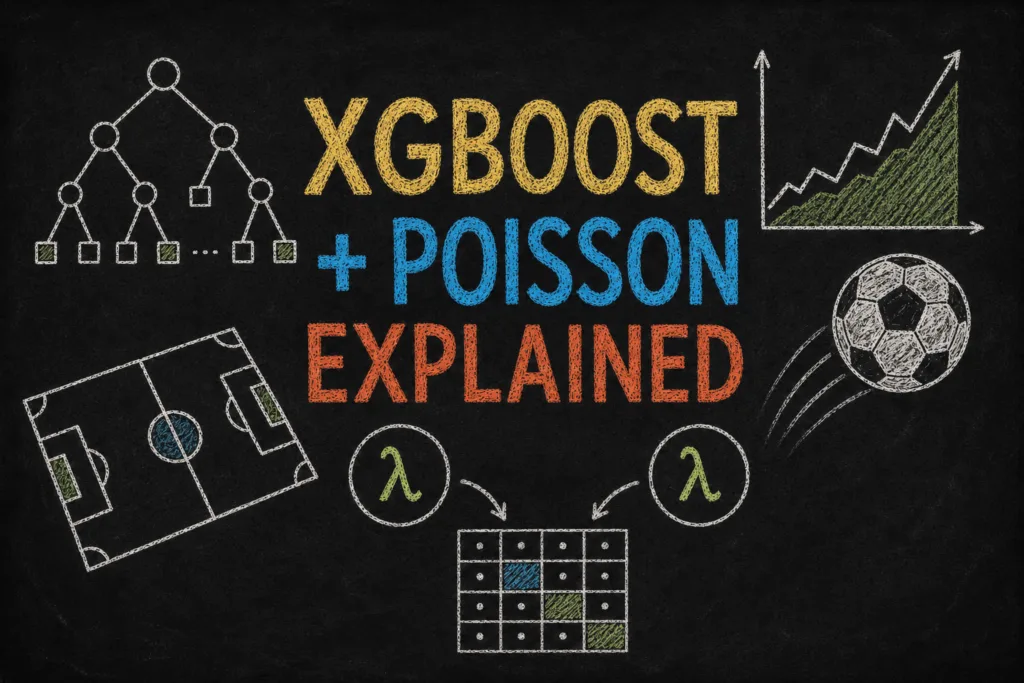
Although this release introduces an XGBoost football prediction model, Poisson mathematics still plays an important role in the eScored engine.
XGBoost now estimates the two most important inputs:
The bivariate Poisson layer then transforms those expected goals into a complete distribution of possible scores. This ensures that related markets remain mathematically connected. For example, Match Winner, Double Chance, Over/Under, BTTS and Asian Handicap probabilities all originate from the same underlying view of the match.
The major improvement is therefore not the removal of Poisson. It is the replacement of the old manually constructed expected-goals engine with a data-driven model that learns nonlinear relationships from historical matches.
Offline model accuracy is not enough. A football prediction system must also work when predictions are generated under real pre-match conditions.
To test this, we ran a live-style historical backfill. For every match, the system:
The live-style results remained close to our offline validation metrics. This gives us greater confidence that the model’s performance is based on genuine pre-match information rather than post-match data leakage.
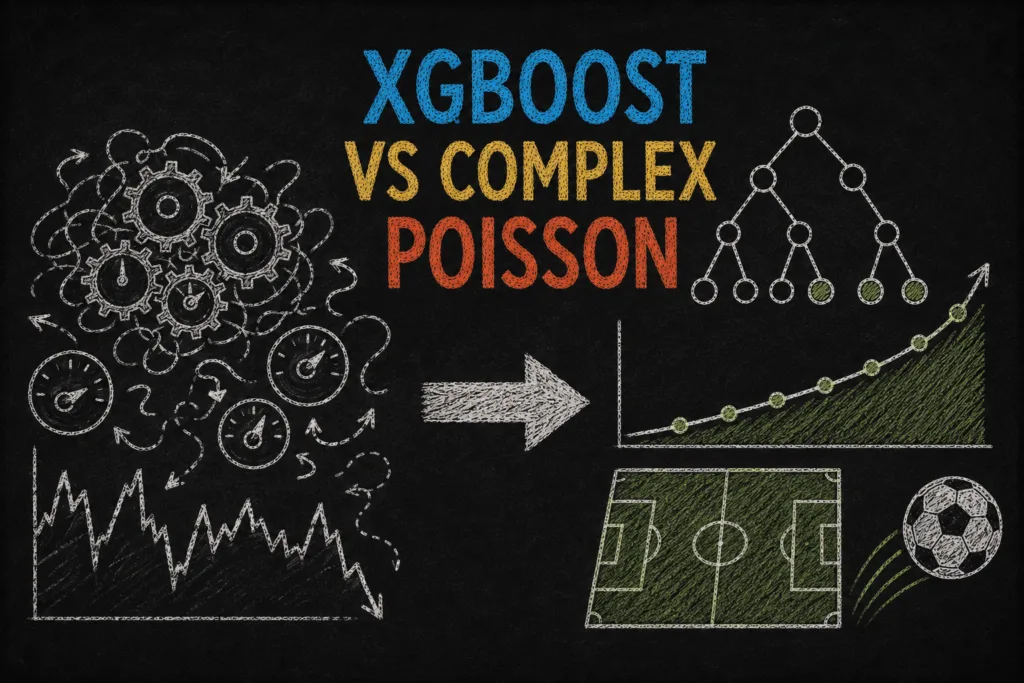
The following benchmark compares the new production configuration with the previous eScored Complex Poisson model over comparable 2500-match validation runs.
| Metric | Complex Poisson | New XGBoost model | Improvement |
|---|---|---|---|
| Home-goal MAE | 1.076 | 0.903 | 16.1% lower |
| Away-goal MAE | 0.953 | 0.824 | 13.5% lower |
| Total-goal MAE | 1.420 | 1.186 | 16.5% lower |
| Home-goal bias | +0.376 | +0.086 | 77% lower absolute bias |
| Away-goal bias | +0.243 | −0.064 | 74% lower absolute bias |
| Total-goal bias | +0.619 | +0.022 | 96% lower absolute bias |
Mean absolute error, or MAE, measures how far predictions are from the final number of goals on average. Lower is better. Bias indicates whether the model systematically predicts too many or too few goals.
The new model’s total bias of +0.022 is particularly important. Across this sample, its average total-goal prediction was almost perfectly centred on the observed results.
| Market | Metric | Complex Poisson | New XGBoost model | Change |
| 1X2 | Hit rate | 49.4% | 53.8% | +4.4 percentage points |
| 1X2 | Brier score | 0.2517 | 0.2339 | 7.1% lower |
| Over 2.5 | Hit rate | 57.6% | 65.2% | +7.6 percentage points |
| Over 2.5 | Brier score | 0.2565 | 0.2220 | 13.5% lower |
| BTTS | Hit rate | 55.4% | 66.2% | +10.8 percentage points |
| BTTS | Brier score | 0.2489 | 0.2210 | 11.2% lower |
The Brier score measures the accuracy of probability forecasts, not only whether the most likely selection won. A lower Brier score means the predicted probabilities were closer to the outcomes that actually occurred.
This distinction matters. A useful football prediction model should not merely select winners—it should estimate uncertainty realistically.
The largest improvements appeared in Over 2.5 goals and Both Teams to Score.
The old Complex Poisson model’s positive goal bias pushed too much probability toward high-scoring outcomes. The new XGBoost expected-goals model, combined with separate home and away calibration, brought the overall goal expectation much closer to reality.
As a result:
0.2565 to 0.2220;0.2489 to 0.2210;65.2%;66.2%.These results do not mean every future prediction will be correct. They show that, across the validation sample, the new model produced substantially better probability estimates than the previous system.
During development, we found that the unadjusted model was too conservative with strong favourites and placed too much probability on low-scoring results such as 0–0, 1–0 and 0–1.
We corrected this through several changes:
In the Asian Handicap −1.5 validation, the original model materially underestimated the home side’s cover probability. After the expected-goals correction, the average predicted probability moved much closer to the observed cover rate and the Brier score improved by approximately 7%.
The 2500-match validation included matches from a broad selection of competitions, including:
The XGBoost model produced a lower total-goal MAE in 13 of the 15 listed competition comparisons. Some of the largest reductions appeared in La Liga, Ligue 1, 2. Bundesliga, Serie A and Eredivisie.
League-level samples are still too small for aggressive competition-specific tuning. We will continue collecting data before introducing any league-level calibration that could overfit short-term results.
The updated engine affects the full prediction experience:
Because every derived market starts from the same expected-goals distribution, the predictions are designed to tell one coherent story about each match.
Prediction Engine 2.0 is a major step, not the end of development. Our next priorities include:
We will continue publishing model changes and validation results as the eScored prediction engine evolves.
eScored now uses a hybrid prediction engine. XGBoost estimates expected home and away goals, while a calibrated bivariate Poisson score matrix converts those estimates into probabilities for match results, totals, BTTS, correct scores and handicaps.
No. We replaced the previous manual method of calculating expected goals. Poisson mathematics remains part of the score-distribution layer because it provides a consistent way to connect multiple football markets.
In the 2500-match benchmark, the new model reduced total-goal MAE by 16.5%, reduced absolute total-goal bias by approximately 96%, and lowered Brier scores by 7.1% for 1X2, 13.5% for Over 2.5 and 11.2% for BTTS.
No. A lower Brier score indicates more accurate probability forecasts over the tested sample. It does not guarantee the outcome of an individual match or future betting profit. Odds, market margins, variance and responsible bankroll management still matter.
No. Football contains red cards, injuries, tactical changes, refereeing decisions and random events that cannot be predicted perfectly. eScored probabilities represent estimates, not certainties.
The move to XGBoost gives eScored a stronger foundation for future football predictions. Compared with the previous Complex Poisson model, the updated engine produces more accurate expected goals, significantly lower bias and better calibrated market probabilities.
Most importantly, the new system has been tested through fresh pre-match inference rather than relying only on saved offline predictions. We believe transparent validation is essential: model updates should be supported by measurable results, not marketing claims.
The upgraded prediction engine is now the primary model powering eScored forecasts.
Responsible Gambling Disclaimer
eScored content is provided for informational and analytical purposes only and does not constitute financial advice or encouragement to gamble. Predictions and statistics do not guarantee winnings. Betting involves the risk of financial loss and is intended only for adults of legal gambling age. You are solely responsible for your decisions and any resulting consequences. Always follow the laws of your jurisdiction and gamble responsibly.
Select matches to build your Betslip