
































Login
Register
Top Leagues
Country
We use cookies to ensure that we give you the best experience on our website.
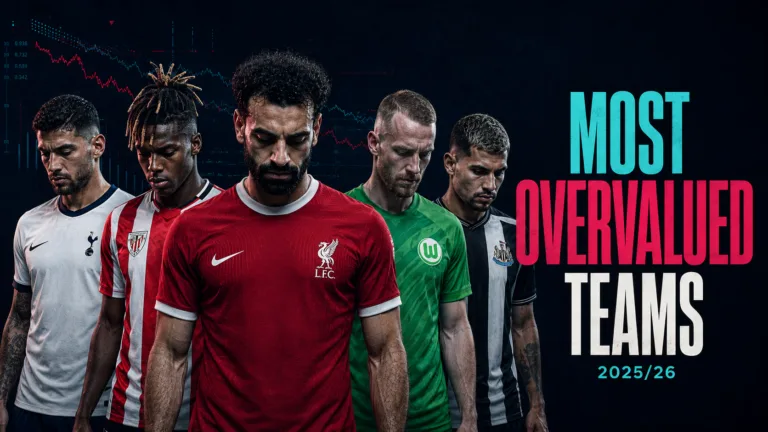
Liverpool spent almost the entire season priced as favourites — even after the results had stopped matching the price. That is not a ranking of Europe’s worst teams. It is a ranking of the clubs whose wins punters and fans were asked to overpay for most often.
A famous shirt is not the same thing as a good bet. Sometimes the fame is exactly what makes the odds worse.
This is not an argument that bookmakers “got it wrong”, and it is not a claim that Liverpool, Athletic Club or Juventus were bad sides. Odds are not a pure strength rating. They absorb demand, injuries, line-ups, public money and whatever news arrives in the 48 hours before kick-off.
What the numbers can show is narrower, and more useful:
for which clubs did the market’s fair win probabilities sit too high, for too long, relative to what actually happened?
In other words: who did the price force you to overpay for?
We took domestic league matches from 2025/26 in Europe’s top five divisions — Premier League, La Liga, Serie A, Bundesliga and Ligue 1 — where pre-match 1X2 odds were stored. That is 1,281 matches, covering roughly three-quarters of the Big Five season.
For each game we stripped the bookmaker margin out of Home / Draw / Away, so the three probabilities sum to 100%. From those fair prices we built expected points:
3 × P(win) + 1 × P(draw)
Then we compared that figure with points actually collected.
A club is overvalued when expected points ran ahead of reality: the market kept handing them a higher share of the result than they delivered. A flat £1 on their win, at the raw decimal odds, is the sanity check. If the gap is large and that bet still loses money, the overpayment was not an optical trick of draws. It sat in the win price itself.
This is not closing-line value against a single book. It is the gap between the fair market probabilities we captured and the results that followed. Twenty to thirty matches is enough to see a pattern. It is not enough to declare a law of nature.
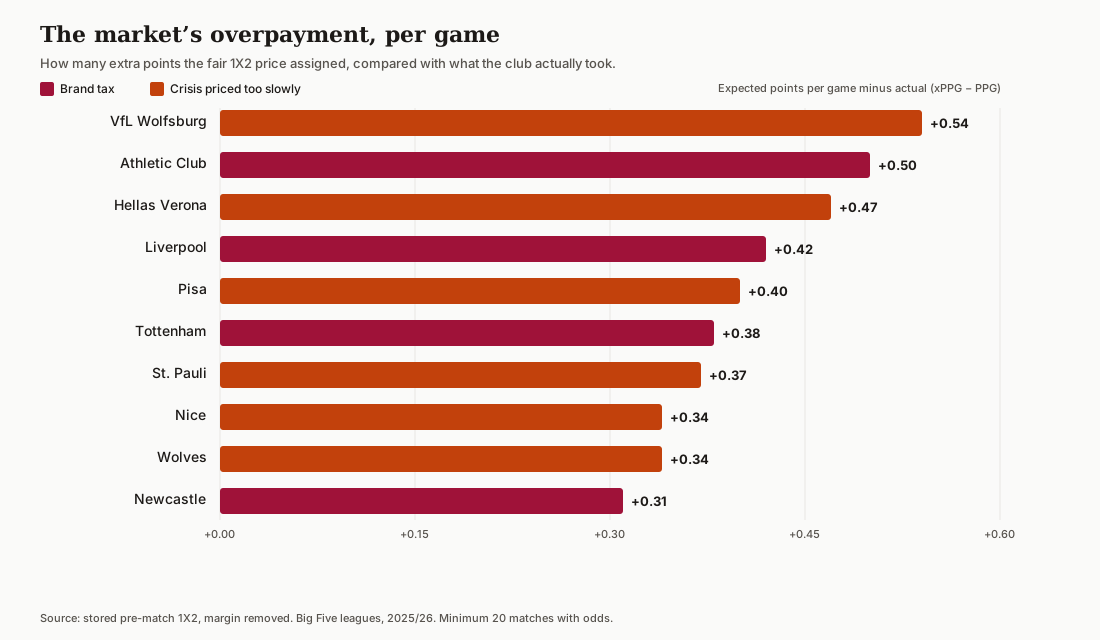
Minimum 20 league games with stored odds. Ranked by expected points per game minus actual points per game.
| Rank | Club | League | Games | Market xPPG | Actual PPG | Extra points the market assigned | Win rate: market vs reality | Flat-stake ROI on the win |
|---|---|---|---|---|---|---|---|---|
| 1 | VfL Wolfsburg | Bundesliga | 24 | 1.20 | 0.67 | +13 | 32% / 17% | −52% |
| 2 | Athletic Club | La Liga | 28 | 1.53 | 1.04 | +14 | 42% / 29% | −39% |
| 3 | Hellas Verona | Serie A | 30 | 1.01 | 0.53 | +14 | 24% / 7% | −70% |
| 4 | Liverpool | Premier League | 28 | 1.84 | 1.43 | +12 | 54% / 39% | −34% |
| 5 | Pisa | Serie A | 29 | 0.89 | 0.48 | +12 | 21% / 3% | −92% |
| 6 | Tottenham | Premier League | 27 | 1.34 | 0.96 | +10 | 36% / 22% | −42% |
| 7 | St. Pauli | Bundesliga | 24 | 1.08 | 0.71 | +9 | 27% / 17% | −53% |
| 8 | Nice | Ligue 1 | 24 | 1.30 | 0.96 | +8 | 35% / 21% | −45% |
| 9 | Wolves | Premier League | 30 | 0.87 | 0.53 | +10 | 21% / 7% | −76% |
| 10 | Newcastle | Premier League | 28 | 1.63 | 1.32 | +9 | 46% / 39% | −22% |
Just behind them: Nantes, Köln, Chelsea, Monaco, Werder Bremen and Juventus.
Two different stories sit in the same table. Mixing them up is how this kind of piece turns into a cheap “worst teams” list.
Some clubs do not need to be in crisis to be expensive. The market already knows their name.
Liverpool is the cleanest exhibit. In 26 of 28 matches they were the favourites. They won 42% of those. The fair price implied a 54% win rate; they delivered 39%. Backing them at those odds returned −34%. None of that says they were a poor Premier League side. It says the price of beating whoever was in front of them stayed too short for what the season actually produced.
Tottenham lived in the same neighbourhood with a worse conversion. The market still saw a win more than a third of the time. Spurs won just over one in five. Ten expected points evaporated. A flat stake on their win lost 42%.
Athletic Club is the most interesting name in the top two, because the brand here is not English-television gravity. It is the aura of a club the market treats as structurally serious. Athletic were favourites 20 times and won 35% of those games. Fair odds implied 42% wins; reality was 29%. Fourteen points the market had already written onto their account never arrived.
Chelsea and Juventus are quieter versions of the same tax. Chelsea: favourites 23 times, 44% wins, −22% on the win. Juventus: favourites 26 times, 46% wins, −17%. These are not collapses. They are seasons in which the shirt still cost more than the results.
Newcastle belong on the edge of this group rather than in the crisis column. The gap is smaller (+0.31 points per game, −22% ROI). The pattern is the same: too often the favourite, not often enough the winner.
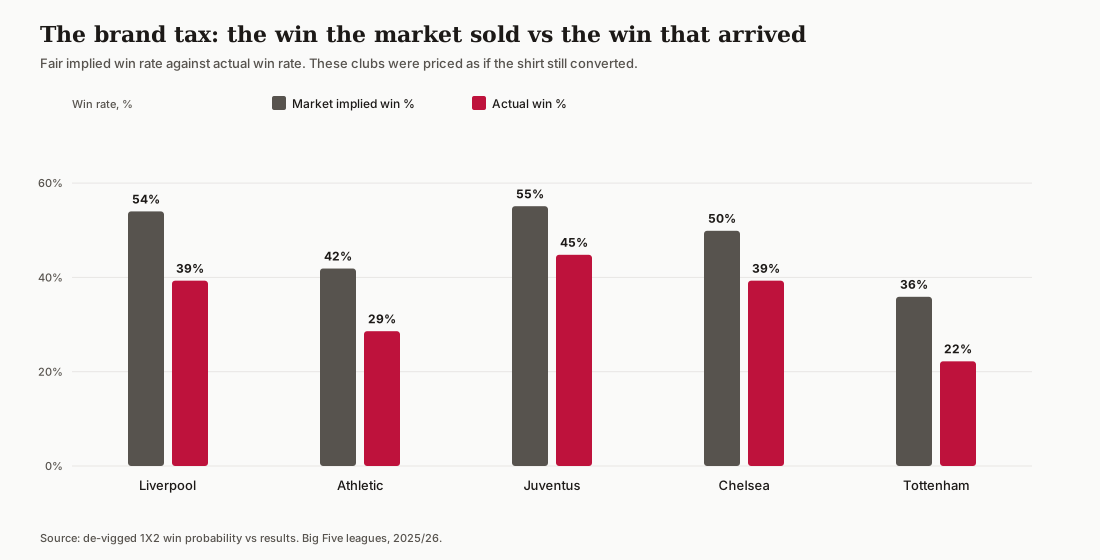
The misconception this group destroys is simple. A club can be strong and still be a bad bet. The public does not overpay because the team is secretly terrible. It overpays because the name keeps the price sticky after the performances have cooled.
The other half of the list is not famous enough to attract a brand tax. These clubs were already supposed to be struggling. The odds still did not fall far enough, or fast enough.
Wolfsburg sit at the top of the entire ranking. The market’s fair price said 1.20 points per game. They took 0.67. Thirteen phantom points. A 32% implied win rate against 17% in real life. Backing them was a −52% season. Wolfsburg were not being sold as a title contender. They were being sold as a competent Bundesliga side for longer than the results allowed.
Verona is harsher. Seven times the market made them favourites. They won none of those matches. Implied wins: 24%. Actual wins: 7%. ROI on the win: −70%. That is not a club the public was romantic about. That is a line that kept a floor under a team which had already fallen through it.
Pisa is the extreme. Three wins in a hundred, against a market that still implied 21%. Stake a unit on Pisa to win all season and you are looking at −92%. Nobody was pricing them as giants. The error was smaller and more stubborn: even a bad team can be too expensive if the win is not cheap enough.
Wolves and St. Pauli complete the set. Wolves: 7% wins, 21% implied, −76% on the win. St. Pauli: nine extra expected points the table never received. These are the clubs where the market recognised trouble and still could not bring itself to price the trouble in full.
Nice sit between the two types — too big to be anonymous, too poor a conversion to be a brand story alone. Favourites 11 times, 27% wins. The price remembered last season longer than this one deserved.
A list of overpayments is only half an investigation. If the market systematically overcharged for some shirts, it also left money on the table elsewhere.
Aston Villa are the counter-exhibit. Fair odds had them at 1.42 points per game. They scored 2.07. Sixty points against 41 expected. The market implied a 39% win rate; Villa won 62%. A flat unit on Villa to win returned +98%. If Liverpool is the season’s most expensive favourite, Villa is the season’s most profitable reminder that the price, not the badge, is the bet.
Sunderland are the other half of that reminder. Promoted clubs are supposed to be overrated by hopeful fans and underrated by a sceptical market. Here the scepticism went too far. Implied wins: 24%. Actual wins: 39%. They were favourites four times and won all four. Fourteen points above the market’s script. Backing them paid +55%.
Lens, Dortmund, Villarreal and Inter all beat their fair expected points as well. And one more name that does not fit the folk tale: Manchester United. In 2025/26 they were not overvalued. They were the other way round — 51 points against 43 expected, +47% on the win. The brand tax landed on Liverpool, Spurs and Chelsea. It did not automatically attach to Old Trafford.
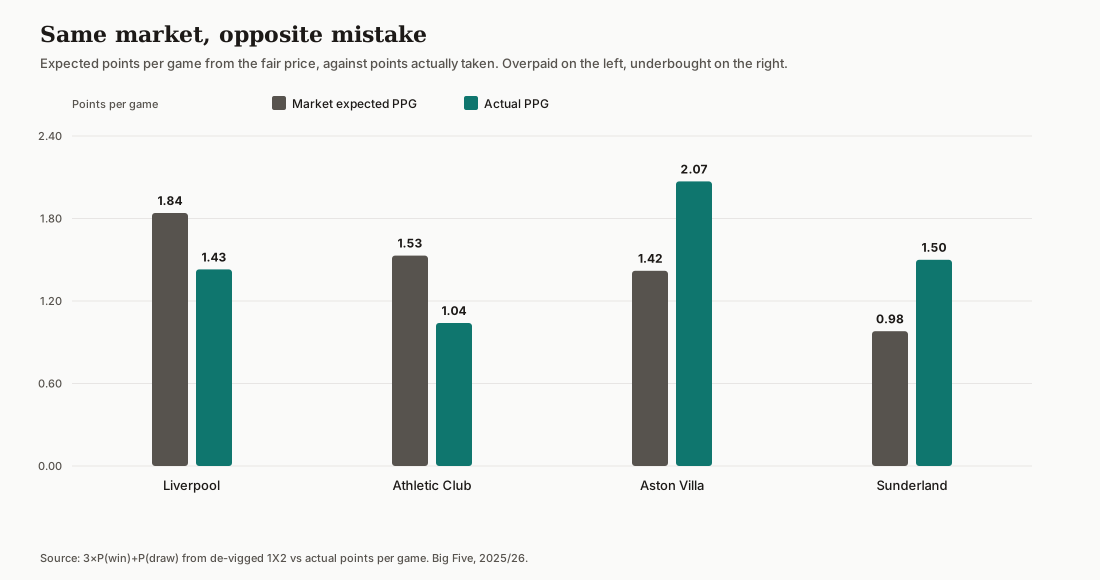
That is the point of the contrast. This is not a morality play about big clubs collapsing. It is a map of where the price and the season came apart.
Not every gap is a betting signal. Monaco show why. They sit in the overvalued half of the table (+0.27 points per game, six expected points unpaid). A flat stake on their win, though, finished at +0.5%. The overperformance of the market lived in draws and in the shape of the 1X2, not in a systematically rotten win price. If you only look at expected points, Monaco look like a short. If you also look at whether backing the win actually lost money, they disappear.
The clubs that survive both tests — a fat expected-points gap and a clearly negative ROI on the win, especially with a high favourite share — are the ones this ranking is for. Liverpool, Athletic, Verona, Spurs, Wolfsburg. Not every name that merely had a disappointing year.
Odds move for reasons that never show up in a season table. A club can be “overvalued” on this measure because the public will not stop backing them, because the squad still looks like a favourite on paper, or because the market is pricing a better second half than the first half delivered. Removing the margin makes the probabilities honest. It does not make them a verdict on any individual bookmaker.
The sample is league football only, and only matches where we had pre-match odds. Cups, continental nights and the missing quarter of the Big Five calendar are outside the frame. Twenty matches can still be a hot or cold run. Nothing here says the same clubs will be overpriced in 2026/27. Markets do adjust — sometimes slowly, sometimes all at once.
This ranking does not say Liverpool or Athletic were poor teams. It says their results were not good enough for the probabilities the market had already baked into the price. For a punter, that distinction is the whole game.
The same price-first principle underpins eScored’s football betting tips, where model probabilities are considered alongside the available odds rather than treating the favourite as an automatic bet.
A strong team can be a bad bet. A modest team can be a good one. Villa were not a miracle. Sunderland were not a glitch. They were clubs the price had not fully caught. Liverpool and Athletic were clubs the price would not fully let go.
The popular belief is that you want to back the famous name because famous names win. The 2025/26 numbers say something colder, and more interesting:
You were not paying for the team. You were paying for the demand to believe in it.
Responsible Gambling Disclaimer
eScored content is provided for informational and analytical purposes only and does not constitute financial advice or encouragement to gamble. Predictions and statistics do not guarantee winnings. Betting involves the risk of financial loss and is intended only for adults of legal gambling age. You are solely responsible for your decisions and any resulting consequences. Always follow the laws of your jurisdiction and gamble responsibly.
Select matches to build your Betslip
Two or more legs are from the same match. Multiplying probabilities overstates the chance — those outcomes share one score.
Unlock joint probability